
Shape Agent Behaviour for Every Scenario
This week, we’re expanding Custom AI Agents with Advanced Agent Rules, giving you more precise control over how your agents behave in different situations.
You can now create rules that tailor your agent’s behaviour to specific use cases and outcomes, making responses more consistent, more structured, and better aligned to how your team actually works.
Whether you want an agent to answer like a compliance specialist, cite a minimum number of sources, or follow a strict response format, Advanced Agent Rules help you define exactly how it should respond.
Fine Tune Behaviour with Rule Based Control
Every team has different expectations for how AI should answer. Some need concise, factual responses for security reviews. Others need structured outputs for procurement workflows or customer-facing use cases.
With Advanced Agent Rules, you can now define behaviour through dedicated rule types that make agent responses easier to guide, standardise, and improve over time.
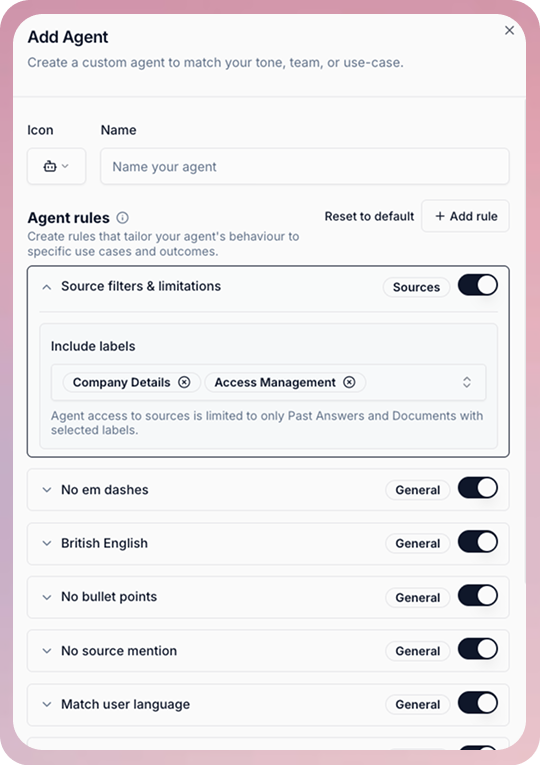
There are now three types of Advanced Agent Rules you can use to shape how your Custom AI Agents respond:
- Source Label Rules Scope each agent to the right knowledge by limiting which labelled content it can access - selected labels, unlabelled content, a combination, or all sources.
- General Rules Shape the agent's tone, reasoning style, and decision-making so it reflects the voice of a specific team or workflow.
- Answer Formatting Rules Standardise the structure, presentation, and language of responses so outputs stay consistent and ready to reuse.
Source Label Rules
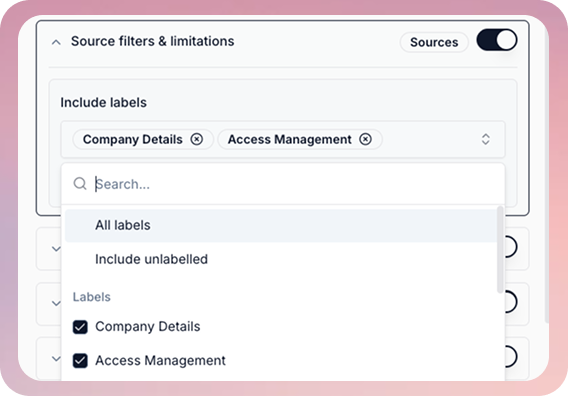
One of the most important controls in Advanced Agent Rules is the ability to limit what your agent can access using source label rules. This allows you to define exactly which labelled content the agent is allowed to use when generating answers, helping keep responses relevant, accurate, and scoped to the right context.
Instead of allowing the agent to search across everything in your workspace, source label rules let you narrow the available knowledge to only the content that matches the labels you choose.
This means you can configure the agent to:
- use only sources that match the labels you select
- include unlabelled sources alongside the selected labels
- include only unlabelled sources
- or allow access across all sources when no label restriction is needed
This is especially useful when labels are used to separate knowledge by customer, product, team, workflow, business unit, or region. That way, each agent can stay within the right knowledge boundary and avoid pulling information from unrelated source groups.
Supported options
- Include all
The agent can use content across all labelled and unlabelled sources. - Selected labels
The agent can use only sources that match the selected labels. - Selected labels + unlabelled
The agent can use sources with the selected labels, while also allowing unlabelled content. - Include unlabelled
The agent can use only sources that do not have labels assigned.
General Rules
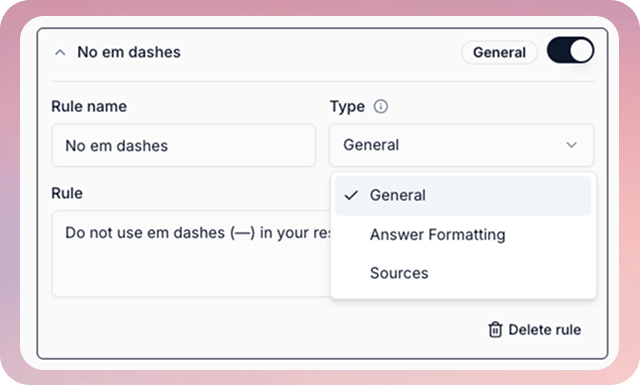
Control the agent’s behaviour, reasoning style, and tone. This is where you shape how the agent approaches answers in a given context.
Example: “Answer as our compliance team for security questionnaires, with a factual and concise tone.”
This is useful when you want your agent to reflect the voice, intent, or decision-making style of a particular team or workflow.
Answer Formatting Rules
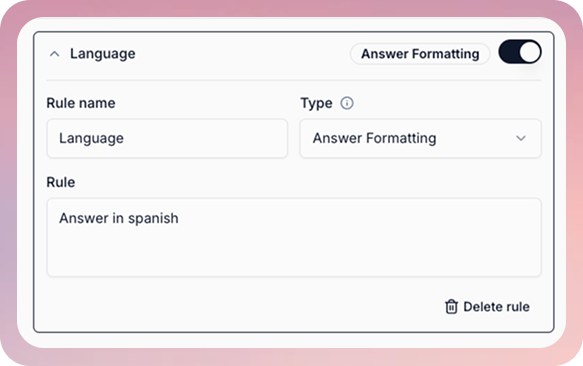
Control the output style, structure, and presentation of the final response. This is ideal when your team needs standardised answers that are easier to review, reuse, or send directly to customers. It can also be used to control the language the agent responds in.
Example: “Start with Yes, No, or Partial, then add up to 3 bullet points.”
Example: “Always answer in Spanish.”
This makes it easier to produce responses that follow a repeatable pattern across similar tasks, while also ensuring the output matches the required language for the audience.
Built with Real Team Workflows in Mind
Every improvement in Vera is shaped by the way teams actually use it day to day. Advanced Agent Rules are part of that continued effort, giving you more practical control over accuracy, consistency, and trust so your agents can better fit the real workflows behind questionnaires, customer trust, and internal collaboration.
As teams take on more complex use cases, Vera is evolving to provide the configuration needed to make AI responses more predictable, more useful, and easier to manage at scale. Your feedback continues to shape what comes next, and we’re building each step forward with that in mind.